Jama Wealth is a digital wealth advisory platform that helps investors discover, subscribe to, and manage professionally curated investment portfolios.
Fixing Onboarding for Wealth Advisory Platform
Fixing Onboarding for Wealth Advisory Platform
Jama Wealth
Jama Wealth
2022
2022
B2C
B2C
Advisory Platform
Advisory Platform
Web App
Web App
Back to Work
How might we help first-time investors complete onboarding with confidence while meeting all regulatory requirements?
The Business Problem
The Business Problem
For a wealth advisory platform, onboarding completion directly impacts activation and revenue.
Design Goals
Design Goals
The research revealed that onboarding friction was not primarily caused by compliance requirements. It was caused by uncertainties.
As the platform scaled, onboarding became a critical bottleneck. While user acquisition remained strong through referrals and marketing campaigns, a significant number of users dropped off before completing account setup and accessing investment recommendations.
The Onboarding journey required users to navigate multiple compliance and verification steps, creating friction at the exact moment trust and confidence were most important.
Every user who abandons Onboarding before completing KYC, Bank Verification, or E-signing is a potential investor lost before experiencing the product's value.
The existing onboarding experience had three major business challenges:
High abandonment during verification steps.
High abandonment during verification steps.
Increased support requests from confused users.
Delayed activation of new investors.
Delayed activation of new investors.
The team needed a way to improve onboarding completion without compromising regulatory compliance requirements.
Research & Discovery
Research & Discovery
To understand this I benchmarked platforms like Groww, Paytm, Zerodha, Kuvera, Upstox. The pattern was consistent across all of them.
I signed up for each one, documented their onboarding steps, and analyzed app store reviews. It gave me an understanding of what worked and what didn’t.
Findings
Findings
Across all platforms, the onboarding flow followed a similar structure:
Sign up via Email/Mobile number
Sign up via Email/Mobile number
Aadhar verification through Digi Locker
Verifying Bank Account
Verifying Bank Account
E-Sign via Aadhar Number.
E-Sign via Aadhar Number.
While the process was largely standardized due to regulatory requirements, the user experience varied significantly.
Users were willing to complete onboarding if:
Users were willing to complete onboarding if:
They understood what was happening.
They understood what was happening.
They knew how many steps remained.
They knew how many steps remained.
The system reduced unnecessary effort.
The system reduced unnecessary effort.
They felt confident they were making progress.
They felt confident they were making progress.
How I attempted to solve this:
How I attempted to solve this:
Automatic Compliance Detection
Automatic Compliance Detection
Users no longer need to understand compliance terminology before getting started. The system handles complexity behind the scenes.
Auto-Fill Instead Of Manual Entry
Auto-Fill Instead Of Manual Entry
Reduces typing effort, Minimizes errors, Improves completion speed and
creates a more modern experience.
Reduces typing effort, Minimizes errors, Improves completion speed and creates a more modern experience.
Progress as a Trust Mechanism
Progress as a Trust Mechanism
Progress visibility reduces anxiety and increases commitment to completion. Instead of feeling trapped inside an endless process, users feel in control.

User Flow
Design Decisions & Trade-Offs
Design Decisions & Trade-Offs
Why not ask users for their compliance status?
Why not ask users for their compliance status?
This was considered during exploration. However, research showed that most users were unsure of their compliance status.
Asking them to choose introduced hesitation at the very first step.
Automatic detection removed an unnecessary decision and reduced cognitive load.

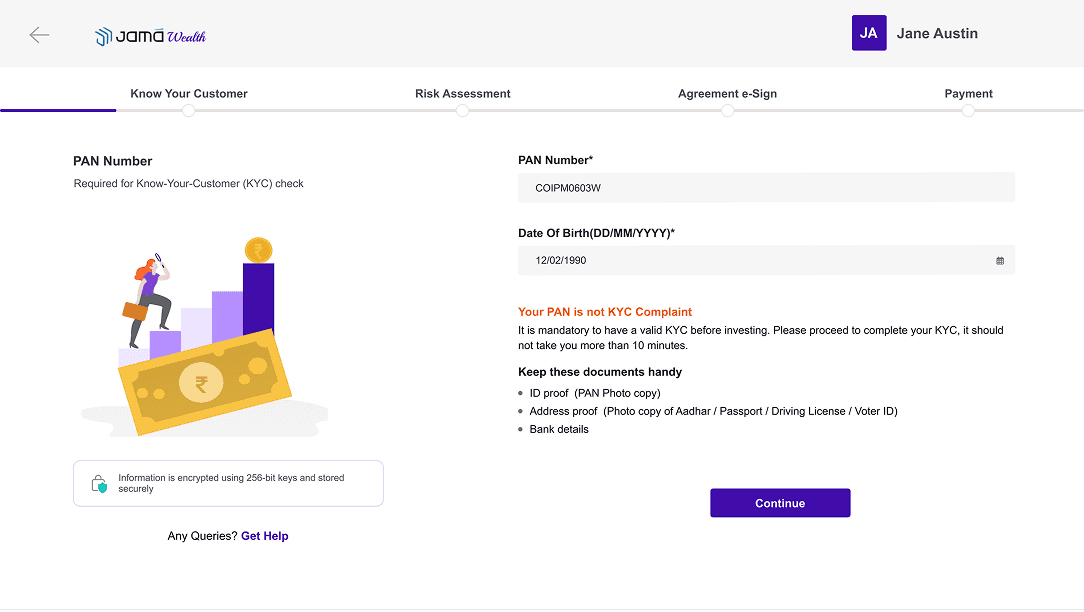
System detects PAN compliance status automatically
It guides user accordingly and alert users to keep required documents handy.
Why use a progress bar instead of checklist?
Why use a progress bar instead of checklist?
A checklist emphasized tasks.
A checklist emphasized tasks.
A progress bar emphasized momentum.
A progress bar emphasized momentum.
Because onboarding was perceived as lengthy, reinforcing progress was more important than reinforcing task completion.

Progress bar carries more weight on the longer path. Showing remaining steps make users stay without drop-off.
User Benefits
User Benefits
Key Learnings:
Key Learnings:
Compliance is not the problem. Uncertainty is.
Most onboarding experiences focus on regulatory requirements and system needs.
The real challenge is helping users understand what is happening, why it is happening, and how close they are to reaching their goal.
By reducing unnecessary decisions, increasing transparency, and adapting the experience to the user's context, onboarding can feel significantly simpler without removing a single compliance requirement.
Jama Wealth - Onboarding
Jama Wealth - Onboarding
It guides user accordingly and alert users to keep required documents handy.
Jama Wealth is a digital wealth advisory platform that helps investors discover, subscribe to, and manage professionally curated investment portfolios.
Every user who abandons Onboarding before completing KYC, Bank Verification, or E-signing is a potential investor lost before experiencing the product's value.
For a wealth advisory platform, onboarding completion directly impacts activation and revenue.
The existing onboarding experience had three major business challenges:
Increased support requests from confused users.
Across all platforms, the onboarding flow followed a similar structure:
through Digi Locker
As the platform scaled, onboarding became a critical bottleneck. While user acquisition remained strong through referrals and marketing campaigns, a significant number of users dropped off before completing account setup and accessing investment recommendations.
The Onboarding journey required users to navigate multiple compliance and verification steps, creating friction at the exact moment trust and confidence were most important.
The team needed a way to improve onboarding completion without compromising regulatory compliance requirements.
To understand this I benchmarked platforms like Groww, Paytm, Zerodha, Kuvera, Upstox. The pattern was consistent across all of them.
I signed up for each one, documented their onboarding steps, and analyzed app store reviews. It gave me an understanding of what worked and what didn’t.
Aadhar verification
While the process was largely standardized due to regulatory requirements, the user experience varied significantly.
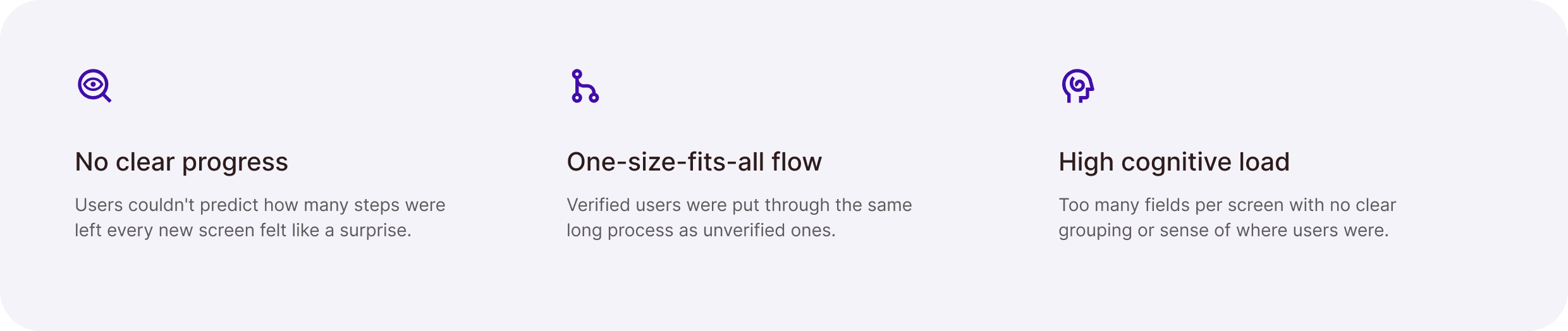
No clear progress
Users couldn't predict how many steps were left every new screen felt like a surprise.
One-size-fits-all flow
Verified users were put through the same long process as unverified ones.
High cognitive load
Too many fields per screen with no clear grouping or sense of where users were.
Increase Confidence
Help users understand where they are and what happens next.
Reduce Effort
Minimize manual data entry wherever possible.
Personalize Journey
Adapt onboarding based on the user's compliance status.
Maintain Compliance
Ensure all regulatory requirements remain intact.
User Flow
This was considered during exploration. However, research showed that most users were unsure of their compliance status.
Asking them to choose introduced hesitation at the very first step.
Automatic detection removed an unnecessary decision and reduced cognitive load.
System detects PAN compliance status automatically
It guides user accordingly and alert users to keep required documents handy.
Progress bar carries more weight on the longer path. Showing remaining steps make users stay without drop-off.
70% faster than manual entry
Reduces user errors in sensitive fields
Builds trust with transparent preview before submit
Cuts drop-off at KYC stage significantly
Most onboarding experiences focus on regulatory requirements and system needs.
The real challenge is helping users understand what is happening, why it is happening, and how close they are to reaching their goal.
By reducing unnecessary decisions, increasing transparency, and adapting the experience to the user's context, onboarding can feel significantly simpler without removing a single compliance requirement.
The research revealed that onboarding friction was not primarily caused by compliance requirements. It was caused by uncertainties.
Users no longer need to understand compliance terminology before getting started. The system handles complexity behind the scenes.
Progress visibility reduces anxiety and increases commitment to completion. Instead of feeling trapped inside an endless process, users feel in control.
Because onboarding was perceived as lengthy, reinforcing progress was more important than reinforcing task completion.
Compliance is not the problem. Uncertainty is.


